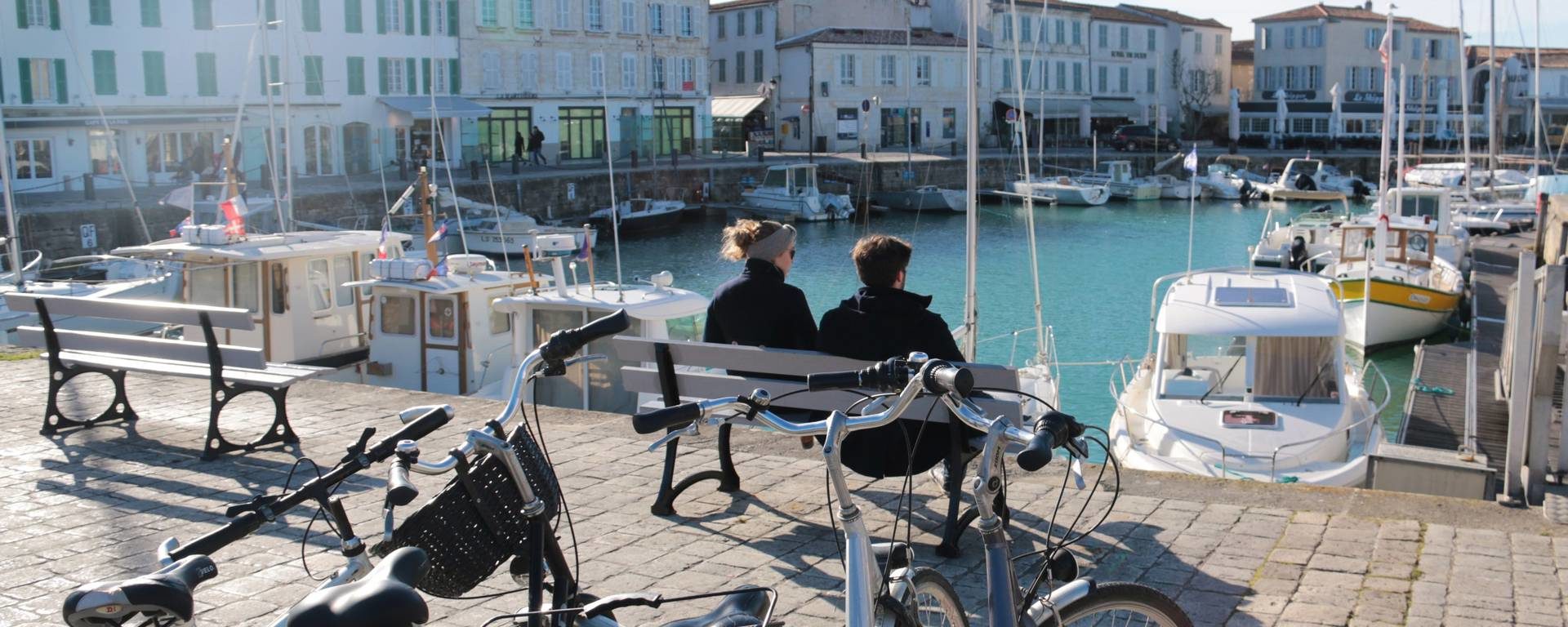
Saint-Martin-de-Ré
Historic capital of the Île de Ré, Saint-Martin-de-Ré is a village with incomparable maritime charm and an essential site to visit.
Organized around its port and protected by its fortified ramparts, it is a must-visit place for vacationing and walking for locals and all visitors to the Île de Ré.
Here, alleyways and lanes hold many treasures of the heritage of Ré: the half-timbered house of La Vinaterie (16th century ), the Renaissance-style Hôtel de Clerjotte or the Citadel which saw prisoners passing on their way to the penal colony.
A bustling town center with houses steeped in history, terraces for chatting, a port where fishermen and yachtsmen rub shoulders in a good mood.
The history of Saint-Martin-de-Ré
The historical, economic and administrative capital of the Île de Ré, Saint Martin appears to have been a village in the 10th century , containing the port as an urban core populated from the Middle Ages by artisans, traders and merchants who exported wine, salt and imported cereals and wood.
The commercial and strategic importance of Saint-Martin-de-Ré places the village at the center of various desires. A first siege of 3 months in 1627 by the Duke of Buckingham leads Vauban to erect between 1681 and 1685 the fortifications and the citadel while developing the port and the seafront. The city will be attacked again by an Anglo-Dutch fleet in 1696 destroying many houses and damaging the church.
This was followed by a period of prosperity in the 18th century , during which beautiful bourgeois houses were built in winding, narrow streets, sheltered from the wind.
From 1874 to 1938, Saint-Martin became the gathering place for convicts before their transport to New Caledonia and especially Guyana.
Today an essential place to visit with a rich historical past, the town of 2700 inhabitants is organized around its port, numerous restaurants, terraces and bistros and its shopping streets with decoration, ready-to-wear and souvenirs.

A Historical Heritage
The Vauban Fortifications
A magnificent star-shaped fortification built at the end of the 17th century by Sébastien Le Prestre de Vauban, then engineer to King Louis XIV, the village has managed to preserve its walls and buildings intact. The town was designed to shelter the entire island's population in the event of an enemy attack. Thanks to this feat of engineering, the town of Saint-Martin-de-Ré was designated a UNESCO World Heritage Site in July 2008 (along with 11 other major sites).
Unique in its dimensions—a semicircle with a radius of 1,5 km and over 14 km of ramparts—the town walls of Saint-Martin-de-Ré were built between 1681 and 1685. To the northeast, they abut a vast citadel, a former military stronghold transformed into a prison in the 19th century . This site, a masterpiece of 17th-century military architecture and the creative genius of Louis XIV's most celebrated engineer, Marshal Vauban, is today magnificently preserved within its setting of undeveloped glacis.

The Prison and the Citadel of Saint-Martin-de-Ré
As you approach Saint-Martin, the silhouettes of the citadel and the prison come into view in the distance. The citadel of Saint-Martin-de-Ré is a military structure built at the end of the 17th century to protect the Île de Ré. It is one of the main historical monuments of the town of Saint-Martin-de-Ré, and today it houses a prison. With 485 inmates, it is the largest central prison in France. It is, of course, not open to the public.
The Port
Lined with restaurants and lively terraces, protected by ramparts and a dyke at the entrance, it consists of a beaching haven and a wet basin regulated by a lock.
In the heart of the village, of which it remains the key element, it effectively shelters fishing and pleasure boats and is a very popular stopover for boaters who appreciate the proximity of the various services and nightlife.
Managing 220 berths year-round, including 52 reserved for passing yachtsmen, the Port Office has all the essential services to facilitate a stopover in Saint-Martin-de-Ré (showers, fuel station, laundromat, handicapped area and babies, technical services for repairs and fairing, weather, wifi, etc,…).
The Ernest Cognacq Museum, art and history of the Île de Ré
Located in a contemporary building, the museum offers a reading of the highlights that shaped the identity of the island; in turn, island of privileges and independence, land of passage and commercial exchanges, island of fortifications, island of peasants and sailors, place of confinement or vacation. The museum also retraces the past of the Martinese city which, from 1873, became the antechamber of the colonial prisons, an obligatory passage for prisoners sentenced to the prisons of Guyana and New Caledonia.
On the ground floor of the Hôtel de Clerjotte, a Gothic building, the thematic collections of the museum are exhibited: marine objects and ship models, Fine Arts as well as part of its ceramic collection.
The Observatory Bell Tower
The Observatory Bell Tower offers a unique panorama over the fortified town but also over the Île de Ré.
The monumental clock, the bells in action and the view are a delight for any visitor. The view is superb at night. The summit of Saint-Martin then reveals a magical universe of the rich heritage of the Cité Vauban where gargoyles and statues converse in silence.
Target Beach
Saint-Martin-de-Ré boasts a beach supervised by lifeguards throughout the summer, certified under the "Bathing Water Quality Approach," a standard created by the Ministry of Ecology that guarantees active monitoring of water cleanliness. For even more comfortable swimming, the town of Saint-Martin-de-Ré provides showers, toilets, and changing cabins ( +33 (0)5 46 09 38 90 ), and access for people with reduced mobility during peak season. For the past three years, the waters at Plage de la Cible have been rated "excellent" with a *** rating.
Source: https://www.iledere.com/decouvrir/10-villages-10-visages/saint-martin-de-re